
Criminal Court Cases in Dutchess County
Dutchess County Court conducts felony trials. City, Town, and Village Courts hear misdemeanors and minor offenses, and they handle the first stages of many felony matters. That split determines where a criminal court case file is kept. A complaint may begin in Poughkeepsie City Court or Beacon City Court, for example, while an indictment or superior court information later creates a Dutchess County Court file. A superior court information, often called an SCI, is a charging document used when a defendant waives grand-jury indictment.
The Unified Court System clerk, not the executive-branch Dutchess County Clerk at 22 Market Street, is the custodian of the criminal file. The Dutchess Supreme and County Court clerk is at 10 Market Street, Poughkeepsie, NY 12601. The main line is 845-431-1720, and the counter is listed as open from 9 a.m. to 5 p.m. The Supreme Court name appears at the same site, but County Court is the felony trial court outside New York City.
Dutchess County Court at Market Street
The 10 Market Street counter is the practical stop for pending felony dockets, archived County Court questions, copies, and certification. Give the clerk the defendant's exact name, date range, and any indictment, SCI, or docket number. State what is needed: a docket check, a filed document, or a Certificate of Disposition. A certificate is the concise official result. It identifies the charge, conviction if any, conviction date, and sentence.
Dutchess Supreme and County Court
10 Market Street
Poughkeepsie, NY 12601
845-431-1720
Monday through Friday, 9 a.m.-5 p.m.
The clerk can also explain whether an older matter is held at that counter or must be retrieved. Court staff can supply access information, but they cannot give legal advice or decide whether a record should be sealed.
Dutchess County Case Record Searches
WebCriminal, also called WebCrims, is the first online channel for covered current and disposed Dutchess County criminal cases. Search by defendant name or case number. Electronic results are case-centered and may show court, charges, appearances, status, and disposition, but they do not promise every pleading, order, exhibit, or old local-court file. When the screen is thin, move to the originating clerk instead of treating the result as the whole record.
- Start in WebCriminal and choose a defendant-name or case-number search.
- Enter the most exact information available and confirm the court and case identifier.
- Read charge, appearance, status, warrant, plea, disposition, and sentence entries as separate events.
- Contact the named City, Town, Village, or County Court clerk for missing documents or older material.
- Request a certified Certificate of Disposition when proof of the final court result is needed.
A court-specific written search is another route. The OCA local search form limits the request to one selected court and prices the search by the date span. The requester supplies a name, address, subject name, exact first and last name, date of birth, and a from-and-to date range.
| Field | Type | Required | Use |
|---|---|---|---|
| Select court and address | Selection/text | Yes | Limits the request to one Dutchess court |
| Requester name and address | Text | Yes | Identifies where the response goes |
| Subject name and DOB | Text/date | Yes | Exact identity match for the search |
| Date range | Date/text | Yes | Sets the two-year search periods |
| Phone and email | Text | Not specified | Useful for status contact |
Note: Town and Village Court information can be limited in statewide electronic results, so the precise local clerk remains an important fallback.
Dutchess County Court Search Costs
A local criminal-record search costs $5 for each two-year period or fraction. Each variation of a subject's name or date of birth counts as its own search. A Certificate of Disposition costs $5 outside New York City. These products answer different questions, so asking for a certificate after already paying for a date-range search is not duplicate work when a certified outcome is needed.
The statewide OCA Criminal History Record Search costs $95 for each exact name and date-of-birth combination. CHRS searches public electronic court data statewide. It is non-certified, not fingerprint based, not nationwide, and not an FBI check. Mail requests go to the OCA Criminal History Record Search Unit, 25 Beaver Street, Room 940, New York, NY 10004. OCA states that this service has no walk-in option.
| Channel | Price | Best use |
|---|---|---|
| Local court search | $5 per two-year span | One known Dutchess court and a set date range |
| Certificate of Disposition | $5 per case | Certified charge, result, date, and sentence |
| OCA CHRS | $95 per name/DOB | Broad public electronic court-history search |
What a Criminal Case File Contains
A Dutchess County criminal case file follows the prosecution, not just the arrest. It can show the accusatory instrument, filed charges, court appearances, motions, plea or verdict, final disposition, and sentence. The first charge may not be the conviction offense. Compare each stage before drawing a conclusion, and use the certified disposition when the result must be clear.
| Case number and court | Identifies the docket and the clerk that holds it. |
|---|---|
| Charging document | May be a complaint, indictment, information, or SCI with cited offenses. |
| Docket entries | Record appearances, filings, motions, orders, and status changes. |
| Plea or verdict | Shows how the filed counts were resolved at the guilt stage. |
| Disposition | States dismissal, acquittal, conviction, or another court outcome. |
| Sentence and warrant status | Records the judgment, sentence, and releasable warrant events. |
The clerk's file is more useful than an arrest log for tracing a final outcome. For the custody event that preceded a case, the separate Dutchess County arrest search explains agency and jail channels.
Dutchess County Case Number Terms
Several identifiers can appear near one prosecution. A docket or case number belongs to a particular court file. An indictment number identifies grand-jury charges filed in County Court. An SCI number identifies the superior court information route. NYSID is the state's identity number within the DCJS criminal-history system, while a DIN belongs to the state corrections system. Those identity numbers do not replace the local court's case number.
- Arraignment
- The court appearance when the charge is stated and a plea is taken.
- Disposition
- The recorded outcome of a charge or case.
- Indictment
- A felony charging instrument returned by a grand jury.
- SCI
- A superior court information used after waiver of indictment.
- Certificate of Disposition
- The clerk's certified summary of the charge, result, date, and sentence.
Search with the court identifier shown on reliable paperwork. A common name alone can return several matters, while an indictment, SCI, or docket number sharply narrows the match.
Criminal Case Stages in Dutchess County
A Dutchess felony can start in a local criminal court, then move to County Court after indictment or an SCI. Each step leaves a different docket entry. Discovery means the exchange of case information. Pretrial motions ask the judge to decide legal issues before trial. A plea or verdict resolves guilt, and the disposition and sentence complete the trial-level record unless an appeal follows.
Case flow: Charges Filed › Arraignment › Pretrial › Plea or Trial › Disposition › Sentencing
That flow explains why the latest entry matters. An early complaint is not a final conviction. A sentence entry without the related disposition may also be hard to interpret. Read the docket in date order and request the filed order when a short online label is unclear.
Dutchess County WebCriminal Search Limits
WebCriminal is an index and case-information channel, not a full digital courthouse file. It may not provide pleadings, exhibits, transcripts, archived papers, or every Town and Village Court matter. A no-result search can reflect an exact-name problem, a lag, incomplete local-court data, sealing, youthful-offender confidentiality, or another lawful omission. It is not proof that no event occurred.
The image below comes from the official New York Senate page for Judiciary Law §255, the rule directing clerks to search and certify records upon lawful request and payment unless access is restricted.
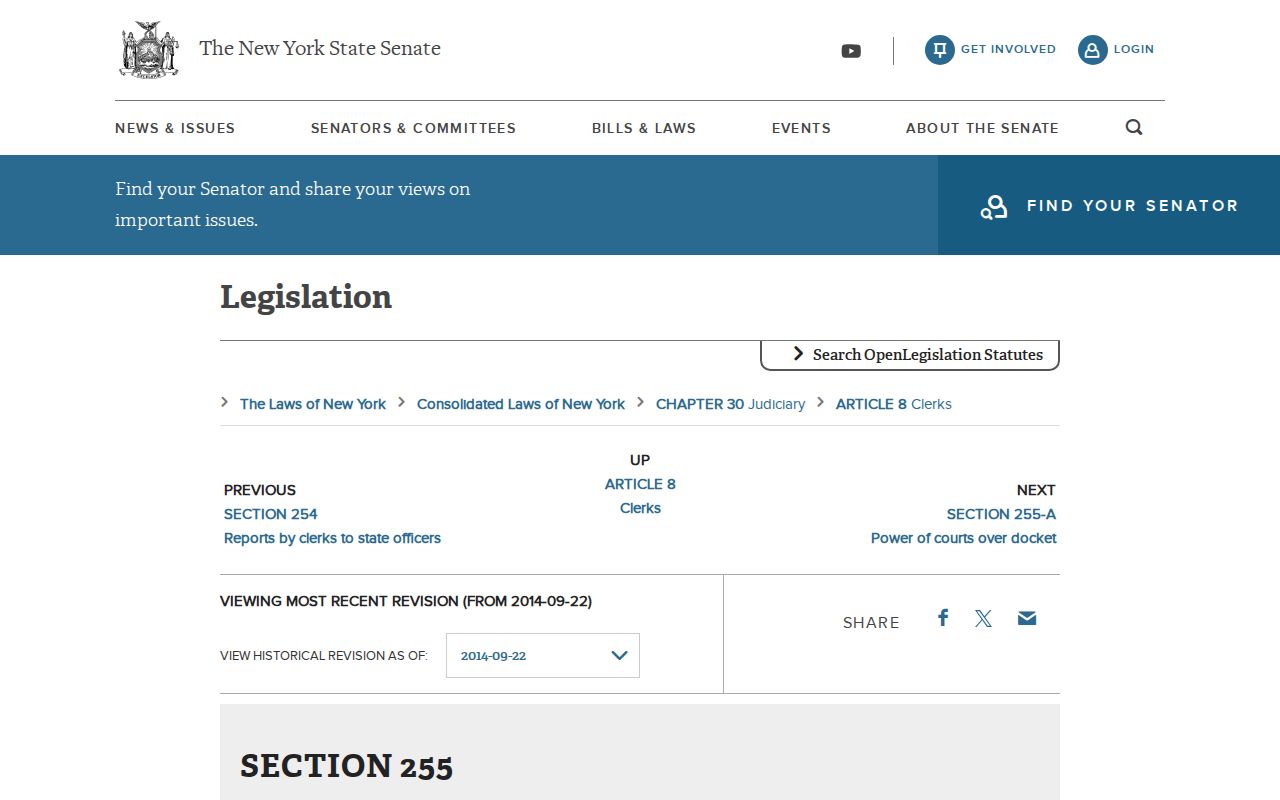
The statute supports the clerk-request path when a Dutchess court case screen does not supply the document or certification a reader needs.
Access Rules for Case Records
Public court access has firm boundaries. CPL §160.50 generally seals favorable-termination records. Youthful-offender adjudications are confidential under CPL §720.35. Clean Slate sealing under CPL §160.57 and ten-year application sealing under CPL §160.59 can also remove qualifying material from ordinary public access. Grand-jury proceedings, sealed warrants, protected victim information, and Family Court material do not become public merely because someone files a FOIL request.
Clerk access rule: Judiciary Law §255 permits lawful searches and certification, but the clerk must honor sealing orders and other statutory restrictions.
OCA CHRS also omits sealed matters, Family Court transfers, noncriminal dispositions, pardoned dispositions, expunged cannabis cases, and other qualifying records. Some inactive cases missing a disposition are omitted after five years unless an open warrant remains. If a case should appear but does not, ask the originating clerk whether the identifiers are correct and whether access is legally restricted.
Federal Court Cases from Dutchess County
A federal prosecution arising in Dutchess County does not become a Dutchess County Court file. The federal layer belongs to the Southern District of New York, whose White Plains courthouse is at 300 Quarropas Street, White Plains. Federal dockets use PACER. That channel is separate from WebCriminal, CHRS, and the 10 Market Street clerk.
PACER charges $0.10 per page with a $30 quarterly waiver threshold through 2026. The published rate changes to $0.12 per page with a $40 threshold on January 1, 2027. Federal custody is searched through the Bureau of Prisons locator, not the Dutchess Justice and Transition Center or New York DOCCS. Keeping the court system and custody system straight prevents a false no-result conclusion.